
The Socialist Position on the Russia-Ukraine War
- MinMin
- 등록 2025.09.05 10:57
- 조회수 2,727
This paper was submitted as a presentation for the ‘Debate: The Russia-Ukraine War from the Perspective of Russian Ethnic Minorities’ held on Friday, August 29.
※Footnotes have been omitted. Please refer to the attached file below for the footnotes.
[Index]
1. Russia's invasion of Ukraine is nothing but reactionary imperialist aggression.
- Putin and Lenin have completely opposite views.
- Stalin destroyed the workers' state through counterrevolution and revived the national oppression on the Ukrainian.
- Today, Russia's invasion only strengthens far-right fascism in Ukraine.
2. Can Western Imperialism and NATO Save Ukraine?
- NATO's eastward expansion policy created Russia's reactionary military response.
- Western imperialism demands submission and minerals from Ukraine.
- The Russia-Ukraine war must be viewed within the totality of imperialist hegemonic conflict.
3. What to Do in an Era of Crisis and War?
- The Ukraine-Russia war has opened an era of crisis and war.
- The Thread of the Movement.
- The Primary Task of Korean Socialists for Peace in Ukraine.
The Russia-Ukraine War began with Russia's invasion on February 24, 2022. Putin boasted he would subjugate Ukraine within three days, but events did not unfold that way. Russia succeeded in occupying the Donetsk and Luhansk regions, followed by most of the Zaporizhzhia and Kherson regions. However, its attempt to capture the capital, Kyiv, along a direct route failed.
Ukraine subsequently launched several counteroffensives. These yielded some limited successes, such as recapturing the city of Kherson in November 2022 and securing Robotyne in Zaporizhzhia Oblast in 2023. In August 2024, Ukraine also launched an offensive in Russia's Kursk Oblast, but it did not achieve significant results. Consequently, the front lines have now solidified, with Russia occupying most of the Donetsk and Luhansk regions, as well as significant portions of Zaporizhzhia and Kherson.
Trump recently held separate talks with Putin and Zelensky about a potential ceasefire and peace deal. Trump seeks to reduce costs in the Ukraine war to focus resources on his strategic goal of confronting China, yet simultaneously avoids appearing to make excessive concessions to Russia. Trump continues his zigzag approach, demanding greater concessions from both Zelenskyy and Putin, making it difficult to predict when a ceasefire or peace agreement might actually materialize.
However, it can be clearly stated that none of the entities conducting or involved in this war are on the side of the suffering Ukrainian and Russian working people. Regarding this reactionary war, 노동해방투쟁연대(No-Hae-Tu), one of the predecessor organizations of March to Socialism, issued a statement on March 1, 2022: "Russia must immediately halt its invasion of Ukraine! The United States and the European Union must dissolve NATO! All imperialist powers must cease their hegemonic rivalry, war preparations, and acts of oppression and plunder!" These slogans remain as valid today as they were then. This article will address several aspects surrounding these slogans.
1. Russia's invasion of Ukraine is nothing but reactionary imperialist aggression.
Putin and Lenin have completely opposite views.
Ukraine endured prolonged national oppression under Tsarist Russia prior to the 1917 Russian Revolution. After the 1917 Revolution, Russian socialists adopted the correct position of guaranteeing Ukraine's right to national self-determination. Lenin spoke at the time about the right to national self-determination for Ukraine and other peripheral nations under Tsarist rule, and their republics' "right to secede from the Soviet Union." Putin's condemnation of this when he declared the invasion of Ukraine in February 2022 profoundly illustrates how completely opposed their positions are.
The following is an excerpt from Lenin's June 1917 writing, revealing what it meant to support Ukraine's right to national self-determination for the unity of Russian and Ukrainian workers and peasants, within the historical context of national oppression under Tsarist Russia.
No democrat, let alone a socialist, will venture to deny the complete legitimacy of the Ukraine’s demands. And no democrat can deny the Ukraine’s right to freely secede from Russia. Only unqualified recognition of this right makes it possible to advocate a free union of the Ukrainians and the Great Russians, a voluntary association of the two peoples in one state. Only unqualified recognition of this right can actually break completely and irrevocably with the accursed tsarist past, when everything was done to bring about a mutual estrangement of the two peoples so close to each other in language, territory, character and history. Accursed tsarism made the Great Russians executioners of the Ukrainian people, and fomented in them a hatred for those who even forbade Ukrainian children to speak and study in their native tongue.
Russia’s revolutionary democrats, if they want to be truly revolutionary and truly democratic, must break with that past, must regain for themselves, for the workers and peasants of Russia, the brotherly trust of the Ukrainian workers and peasants. This cannot be done without full recognition of the Ukraine’s rights, including the right to free secession.
We do not favour the existence of small states. We stand for the closest union of the workers of the world against “their own” capitalists and those of all other countries. But for this union to be voluntary, the Russian worker, who does not for a moment trust The Russian or the Ukrainian bourgeoisie in anything, now stands for the right of the Ukrainians to secede, without imposing his friendship upon them, but striving to win their friendship by treating them as an equal, as an ally and brother in the struggle for socialism.
In his speech launching the invasion of Ukraine, Putin condemned Lenin's position as follows:
Let us begin with the fact that modern Ukraine was created entirely by Russia, or more precisely, by Bolshevik Communist Russia. This process began practically immediately after the 1917 Revolution, and Lenin and his comrades did this in a manner that was extremely rude to Russia. It was a manner of separating and seizing Russia's own historical territories from Russia.
…
From the perspective of Russia and the Russian peoples' historical destiny, Lenin's principles of state-building were far worse than mere mistakes.
Putin's argument is that after the Russian Revolution led by Lenin, the workers' state adhered to the principle of national self-determination and enshrined it in the Soviet constitution, which enabled Ukraine's independence and thereby harmed the Russian people. Clearly, Putin is not a successor to Lenin's workers' internationalism but to the Great Russian nationalism that followed Stalin. Putin's rhetoric that invading Ukraine was unavoidable to protect Russians in Donetsk and Luhansk from fascism is a carbon copy of Hitler's rhetoric a month before annexing Austria, when he claimed German expansion was inevitable "to protect the German people."
“There are more than ten million Germans in states adjoining Germany which before 1866 were joined to the bulk of the Gemman nation by a national link. … political separation from the Reich may not lead to deprivation of rights, that is the general rights of racial self-detemmination which were solemnly promised to us in Wilson's Fourteen Points as a condition for the armistice. … But just as England stands up for her interests all over the globe, presentday Germany will know how to guard its more restricted interests. To these interests of the German Reich belong also the protection of those German peoples who are not in a position to secure along our frontiers their political and philosophical freedom by their own efforts.
Stalin destroyed the workers' state through counterrevolution and revived the national oppression on the Ukrainian.
Today, Ukraine exists upon the legacy of the state-capitalist Soviet Union that emerged from Stalin's counterrevolution. Let us briefly examine that history. Until the early to mid-1920s, the Russian workers' state respected the autonomy and national demands of the Ukrainian Soviet Republic, based on the right to national self-determination formalized by Lenin.
In 1923, the 'indigenization' policy was introduced across the entire Soviet Union, urging measures tailored to the nationalities and cultures of each republic. This policy was also aimed squarely at Ukraine. … The proportion of Ukrainians, which had been 35 percent of government employees and 23 percent of Communist Party members in 1922, rose to 54 percent and 52 percent, respectively, between 1926 and 1927
…
The use of the Ukrainian language was also encouraged. Government employees who did not speak Ukrainian were required to take Ukrainian language courses and were dismissed if they failed to learn it within a year. The proportion of Ukrainian-language government documents and publications rose from 20 percent in 1922 to 70 percent in 1927. Party work was also conducted in Ukrainian.
…
Ukrainization also took place in school education. By 1929, 80 percent of general education and 30 percent of university education were conducted exclusively in Ukrainian. The Ukrainization of newspapers and books was also promoted, increasing the proportion of Ukrainian-language publications among all publications from 27 percent in 1922 to over 50 percent in 1927. … Historian and former President of the Central Rada, Hrushevsky, also returned and began researching Ukrainian history as a full member of the Academy.
…
Ukrainization affected religion as well. The Ukrainian Orthodox Church had long sought independence from Moscow. In 1920, the 'Ukrainian Autocephalous Orthodox Church' was established, and in 1921, the Bishop of Kiev and All Ukraine was appointed. Ukrainian, not Church Slavonic, was used in the rites of the Autocephalous Church.
However, after Stalin seized power within the Soviet Communist Party in the mid-1920s and unilaterally pushed forward the Five-Year Plan for economic development based on the theory of socialism in one country during the 1930s, systematic national oppression against Ukraine was revived. One of the horrific consequences was the Ukrainian famine of 1932. Stalin suppressed Ukrainian resistance to ethnic oppression and famine with brutal purges.
Ukrainization continued into the early 1930s, though crackdowns began as early as the late 1920s. The turning point came when Stalin (1879-1953) seized power in 1927, expelling rivals like Trotsky (1879-1940) and Zinoviev (1883-1936) after Lenin (1879-1924), who was principled yet tactically flexible, died at age 53.
... As described earlier, Stalin sometimes viewed peasants as a force resisting socialism, believing he had no choice but to employ harsh means to integrate them into his vision of a socialist system. ... This led to the collectivization of agriculture, which began in 1928 and was enforced starting in 1929.
… The peasants resisted. Those forced into collective farms slaughtered their livestock for food or sold them off. Between 1928 and 1932, Ukraine lost half its livestock. Yet the Party and government mobilized every means to push forward collectivization. Those who resisted were arrested and sent to Siberia.
… This collectivization in Ukraine proceeded rapidly in 1930 and 1931. As a result, the proportion of collectivized farms in Ukraine rose from 3.4 percent in 1928 to 91.3 percent by 1935.
…
Collectivization may have contributed to the perpetuation of Stalin and Party rule, but it brought catastrophic consequences to Ukraine. The result was the Great Famine of 1932-1933.
In 1930, Ukraine's grain production was relatively good at 21 million tons, with government requisitions amounting to 7.6 million tons. This requisition volume was already double that of the 1920s. 1931 saw a poor harvest, yielding only 14 million tons, 65 percent of the previous year's amount, yet the requisition volume remained unchanged. In 1932, production again fell to 14 million tons, matching the previous year's poor harvest. This decline in yields was primarily caused by the chaos resulting from collectivization.
... Farmers resisted this procurement method, but the Party and government in Moscow pushed it through forcefully. Party activists had the legal right to seize grain from farmhouses. Groups of urban Party activists visited farms, going door to door, even breaking down floors to find grain. Those who were not starving were considered to have hidden food. A law was enacted stating that those who hid food were considered to have stolen socialist property and were subject to the death penalty.
Thus, the famine reached its peak by the spring of 1933. The famine occurred within the Soviet Union itself, specifically in Ukraine and the North Caucasus. It was an extremely abnormal situation: it was not the urban dwellers but the grain-producing peasants who starved, and it occurred not in the grain-poor central regions of Russia but in the breadbasket of Ukraine. Farmers ate rats, tree bark, and leaves for lack of bread. Numerous accounts also describe cannibalism. Entire villages were wiped out. Khrushchev's memoirs recount an anecdote: a train arrived at Kiev Station loaded with the bodies of starved people, having continuously picked up corpses from Poltava all the way to Kiev.
…
The exact number of famine victims remains unknown because the Soviet government concealed it. One scholar estimated between 3 and 6 million. After independence, According to Everything About Ukraine (1998), which includes the official Ukrainian position and a foreword by President Kuchma (1938-), 3.5 million people starved to death in the Ukrainian Republic during this famine. Population decline, including reduced birth rates, reached 5 million. Additionally, approximately 1 million Ukrainians residing in the North Caucasus lost their lives. According to Gorbachev (1931-), who hails from the North Caucasus and whose maternal lineage is believed to be Ukrainian, one-third of his own village perished in this famine.
…
The first characteristic of this famine is that it was an artificial famine caused by forced collectivization and grain requisitioning, and it was not inevitable. In this sense, some scholars point out that this famine was a genocide comparable to the Holocaust perpetrated by the Jews. The second characteristic is that Russia itself hardly suffered from this famine. This has led to the theory that Stalin deliberately orchestrated it to weaken Ukrainian nationalism. Evidence cited includes Stalin's statement, "The national question is the peasant question," and a 1930 Pravda article stating, "Collectivization in Ukraine has the special task of destroying the basis of Ukrainian nationalism (agriculture based on individual peasant farms)." The third characteristic is that this famine was concealed as much as possible within the Soviet Union. Officially, it was treated as if it did not exist. ... Even by 1986, the Soviet-controlled history of Ukraine merely stated that 'there was a severe food problem,' making no mention whatsoever of the famine itself.
…
With Stalin's consolidation of power, restrictions began to be imposed on Ukrainian autonomy. This trend intensified as Ukrainians resisted agricultural collectivization and grain requisitioning. Attacks also began against the intellectual cultural figures active in the 1920s. In 1931, the history department of the Hrushevsky Academy was closed. He was exiled to Russia and died in isolation in the Caucasus in 1934.
Around 1932, purges of Communist Party members commenced. Since the Great Purge across the entire Soviet Union occurred from 1936 to 1938, the purges in Ukraine effectively began several years earlier. ... Stalin blamed Ukrainian Communist Party members for the famine that struck in 1933. That same year, he drove Skrypnyk (1872-1933), a veteran Bolshevik who had promoted the Ukrainization of education and served as Education Commissar (Minister) of the Ukrainian Soviet Republic, to suicide. Other influential party members who had pushed for Ukrainization also vanished abruptly, either committing suicide or being exiled. It is said that the Ukrainian Communist Party lost 100,000 members between 1933 and 1934.
…
From 1936 to 1938, the targets of the purges expanded to include all Soviet citizens, including Ukrainians. Seventeen ministers of the Ukrainian government were arrested and executed, while Prime Minister Lyubchenko (1897-1937) committed suicide. A hundred and seventy thousand members, representing 37 percent of the Ukrainian Communist Party, were purged. This left the Ukrainian Communist Party in a state of collapse. By the late 1930s, the autonomy of the republics had largely been completely extinguished.
…
Education and culture across the entire Soviet Union were standardized and Russified. In Ukraine too, Russian-language education became mandatory. The Ukrainian alphabet, vocabulary, and grammar grew closer to Russian. Ukrainians were encouraged to read the literature of Russian authors like Pushkin, Tolstoy, and Dostoevsky. The proportion of Ukrainian language in newspapers and magazines also decreased. Thus, the Ukrainian culture that had flourished in the 1920s completely vanished during this period.
After Stalin's death, the Khrushchev era saw some conciliatory policies toward Ukraine. However, within the larger framework, Ukraine endured persistent national oppression under the Soviet Union-which had become state capitalism after the Stalinist counter-revolution-until the Soviet collapse. The Soviet bureaucratic command economy stifled Ukraine's industrial and agricultural production. The 1986 Chernobyl nuclear disaster, coupled with the revelations of historical facts like the 1930s famine and purges through Gorbachev's glasnost, unleashed Ukraine's national anger toward the Soviet Union.
During the Brezhnev and Chervitsky eras in Ukraine, the use of Russian was encouraged, while the use of Ukrainian was subject to interference. ... As a result, the proportion of Ukrainian-language newspapers decreased from 46 percent to 19 percent between 1969 and 1980, and the number of books published in Ukrainian fell from 60 percent to 24 percent between 1958 and 1980.
…
Regarding the economic situation, the Khrushchev era retained an ambitious drive with the goal of surpassing the United States, but the economic growth rate began to gradually decline. By the Brezhnev era, the economy had entered a state of stagnation universally acknowledged. The annual growth rate of Ukrainian industry during the Fifth Five-Year Plan (1951-1955) was 13.5 percent, but by the Eleventh Five-Year Plan (1981-1985), thirty years later, it had fallen to 3.5 percent. Industrialization and urbanization caused severe energy shortages, and from the 1950s to the 1970s, massive dams were successively built on the Dnieper River, transforming it into a series of artificial lakes.
…
Agriculture throughout the Soviet Union, including Ukraine, stagnated. By the late Brezhnev era, importing grain from the Soviet Union became commonplace. This situation stemmed from inefficiencies caused by bureaucratic control, diminished work motivation due to the absence of profit incentives and competition. This point is conversely demonstrated by the high productivity of private vegetable gardens attached to homes, where profit incentives operated. In 1970, private vegetable gardens, which covered only a few percent of Ukraine's total farmland, accounted for 36 percent of farm household income.
…
The first major catalyst for distrust of the Soviet system in Ukraine was the Chernobyl nuclear power plant explosion. On April 26, 1986, the fourth reactor at the Chernobyl Nuclear Power Plant, located about 100 kilometers north of Kiev, exploded. Four percent of the 192 tons of nuclear fuel was released into the atmosphere, dispersing radiation equivalent to 500 Hiroshima-type atomic bombs. While the accident itself was an unprecedented disaster, the Soviet Union's cover-up structure further exacerbated the situation. Gorbachev had been in power for just over a year, and glasnost had not yet taken hold, so the accident was concealed until the 28th. Consequently, many lives that could have been saved were lost, and tens of thousands of people still suffer from the aftereffects today. ... The Soviet Union, driven by its obsession with production, had long been almost indifferent to environmental issues. When problems arose, they were simply concealed. Ukraine boasted of being the Soviet Union's primary heavy and chemical industrial zone, but in reality, pollutants from factories and mines were overflowing. Southern and eastern Ukraine became some of the most heavily polluted areas in the Soviet Union, leading to serious health problems for residents.
As glasnost took hold, pent-up grievances erupted. Movements emerged to clarify the long-tabooed 'blank' in history. The famine of 1932-1933 was openly discussed, and mass graves of people murdered by the secret police during the 1930s and 1940s were discovered.
Under the Soviet Union's weakened grip, Ukraine's independence movement began in 1989. In the March 1990 elections for the Verkhovna Rada (Supreme Council), the parliament of the Ukrainian Soviet Socialist Republic, forces advocating Ukrainian independence won a quarter of the seats. On July 16, 1990, the Ukrainian Supreme Council issued a declaration of sovereignty. On August 24, 1991, it adopted a declaration of independence almost unanimously. Subsequently, on December 1, 1991, independence was confirmed by a referendum with 90.2 percent approval.
After the collapse of the Soviet Union in 1991, Ukraine became an independent state. Ukraine inherited a corrupt bureaucratic ruling class (oligarchs) from the Soviet Union, a legacy that continues to oppress the Ukrainian people to this day. During the 2004 Orange Revolution and the 2014 Euromaidan movement, 'end corruption' was a common slogan among the Ukrainian people. Following the Soviet collapse, Ukraine's political trajectory has oscillated between pro-Russian and pro-Western ruling factions, with corruption permeating both camps. Zelensky, elected in 2019 on a platform of "corruption eradication," is now embroiled in corruption scandals himself. In July 2025, large-scale protests erupted against Zelensky's bill to control anti-corruption agencies.
Today, Russia's invasion only strengthens far-right fascism in Ukraine.
Putin cited the growth of 'neo-Nazis' in Ukraine as justification for the invasion. Yet, in reality, far-right and fascism is indeed growing in Ukraine. Volodymyr Ishchenko, a Ukrainian sociologist and editor of 'Lefteast', described the state of Ukraine's far-right in an interview with the French socialist magazine Revolution Permanente as follows:
… For example, in France the far right, mainly the National Rally, Le Pen’s party, is way less extreme than those movements we discuss in Ukraine. Le Pen’s party probably doesn’t use Nazi symbols, and has a more sophisticated attitude towards the Vichy collaboration during the Second World War. They’re trying to detoxify themselves. It’s not like this in Ukraine and you mentioned Stephan Bandera, who is glorified openly; even more so, the Waffen SS is glorified, particularly by people in Azov. The scale of extremism of the Ukrainian far right is way higher than the western one. Recently they had an international conference Nation Europa in Lviv, the biggest city of western Ukraine, to which they invited groups like the Dritte Weg from Germany, Casa Pound from Italy, and similar neo-Nazi groups from many European countries. From Ukraine, all the major far-right organizations participated, including Svoboda party and prominent members of Azov/National Corps. These Ukrainian parties, organizations, and military units are typically called just “far right” yet they build their international relations with the far more extreme and violent groups in the west rather than the dominant far-right parties. By the way, most of the Ukrainian military units who participated in this conference have connections to the Ukrainian military intelligence (HUR).
…
Unlike the major far-right parties in the west who are working on parliamentary status, the power of the far right in Ukraine has always been their capacity for street mobilization and the threat of violence. Significantly, they have not been capable of becoming electorally popular, with one exception in the 2012 elections when far-right Svoboda party won over ten percent of the votes (although they were also capable of gaining a much more significant representation in and have the largest factions in many local councils in western Ukraine). However, the main source of power has come from their capacity for extra-parliamentary mobilization in contrast to oligarchic parties or the weak liberals.
The Ukrainian nationalists can rely on a political tradition that comes back to the Organization of Ukrainian Nationalists (OUN), which belonged to a family of fascist movements in inter-war Europe. ... Now Azov has become very legitimate as heroes of the war. They enjoy extraordinary media attention and project themselves as an elite unit, a statement which is ascertained by the media. Many Azov speakers have become celebrities. They also benefited from some whitewashing in the western media who used to call them neo-Nazi’sbefore 2022. Now they easily forget that part of the story.
The final point is that we need to think not only about the nominal far-right but also about the complicity of the Ukrainian and western elite in the whitewashing of Ukrainian far right and ethnonationalism. … For example, Marta Havryshko, a Ukrainian historian who moved to the United States, continues to write critically about Ukrainian nationalists, Ukrainian ethno-nationalist policies, the Ukrainian far right, and she receives thousands of threats, including death threats and rape threats.
In your opinion, is Azov the principal force of the Ukrainian far right? It has been severely weakened by the battle of Mariupol and Bakhmout. Do you think they will still play an important role in the future, in the recomposition of the far right?
On the contrary, they expanded, they are now two brigades ? the 3rd Assault brigade and Azov brigade in the National Guard ? plus a special unit Kraken subordinated to the military intelligence. Their political attraction and media publicity has expanded enormously. Their whitewashed legitimacy has expanded too, so they’re not weakened but strengthened. Contrary to the popular myth, they have not depoliticized.
What Putin doesn't mention, however, is that Russia's repeated invasions and military threats have created fertile ground for fascism to grow in Ukraine. Through this war, Ukraine's far-right elements, including the Azov Battalion, have gained the title of 'war heroes' and an opportunity to further expand their influence. To prevent the growth of fascism in Ukraine, this reactionary war must be stopped immediately.
To summarize: Russia invaded Ukraine using "Ukrainian fascists" as a pretext, but this is merely a means to justify Russia's imperialist expansionist ambitions. The history of national oppression under state capitalism in the Soviet Union, which persisted for a long time after the Stalin counter-revolution, provided the conditions for far-right nationalism to grow in Ukraine. To untangle this knotted thread of history, the Russian working class must first and foremost recognize Ukraine's right to national self-determination, even today. Imperialist Russia's invasion of Ukraine is nothing but a reactionary war of aggression that strengthens Ukrainian fascism.
2. Can Western Imperialism and NATO Save Ukraine?
We have discussed the historical background of Russia's invasion of Ukraine and why it is an imperialist and reactionary war of aggression. Now we turn to another aspect of the situation: the hypocrisy of NATO and Western imperialism.
NATO's eastward expansion policy created Russia's reactionary military response.
In 1990, U.S. Secretary of State James Baker stated while stationing NATO forces in unified Germany, "NATO will not move one inch further east." However, this was nothing more than empty rhetoric, and NATO has continuously expanded eastward by accepting new members.
Contrary to the U.S. Secretary of State's declaration at the time of German reunification that NATO would "not advance one inch further," the alliance has rapidly expanded its membership toward Russia's borders. Poland, Hungary, and the Czech Republic joined NATO in 1999. Bulgaria, Estonia, Latvia, Lithuania, Romania, Slovakia, and Slovenia received official invitations to join in 2002 and completed the accession process two years later. Albania and Croatia joined in 2009, and North Macedonia joined in 2020. Ukraine, which shares a vast physical border with Russia, applied for the Membership Action Plan (MAP) in 2008 as part of the NATO accession process and formally set membership as its goal in 2014 following the Euromaidan protests.
During his invasion of Ukraine, Putin also cited James Baker's words in a speech, using NATO's persistent eastward expansion as justification for his aggression. Indeed, NATO has repeatedly expanded eastward since the Soviet Union's dissolution, increasing its military threat to Russia. While this does not justify Russia's invasion of Ukraine, It is clear that NATO's continued eastward expansion has provoked Putin's reactionary response in the form of the war in Ukraine.
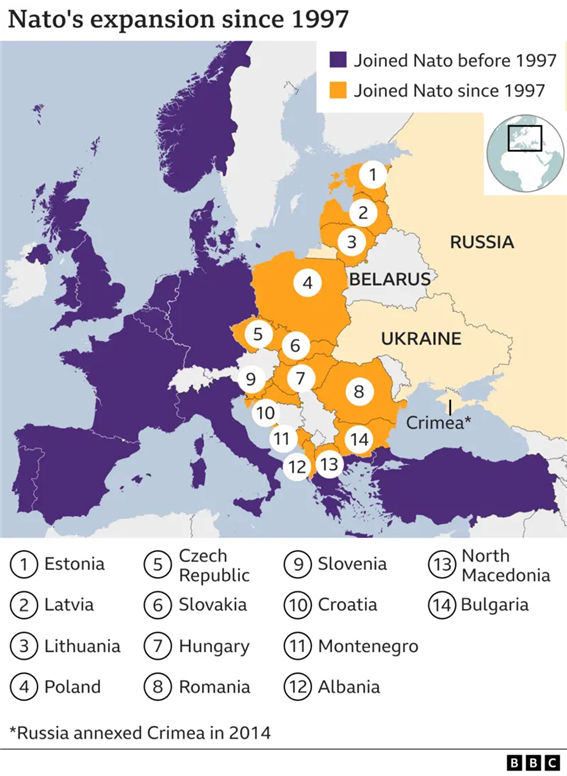
[Map showing NATO expansion since 1997]
NATO has continuously expanded its influence under the pretext of Russian military threats. However, as German socialist Nathaniel Flakin points out, these threats are deliberately exaggerated.
At this moment, NATO countries are spending historic sums to arm the Ukrainian government. The U.S. Congress, including “socialists” in the Democratic Party, just voted for $40 billion for additional weapons. Germany’s capitalists want an additional €100 billion for their army. We are told that this is necessary to “protect democracy,” not just in Ukraine but around the world.
…
The reality, of course, is that the army of Russia’s corrupt regime can barely grab slivers from one of the poorest countries in Europe. NATO’s new militarism has nothing to do with defense ? it’s about shoring up imperialist hegemony and preparing for greater confrontations with China. All these new weapons will be used for new imperialist adventures, as in Iraq and Afghanistan.
A similar discussion was going on in 1914. The German Empire claimed that it needed to defend itself against the Russian autocracy, which was indeed the most barbaric state in Europe. The German generals told the socialist leaders that the war was about defending the limited freedoms enjoyed by the working class in Germany. The czar, after all, allowed no socialist organizing of any kind. But these same German generals then abolished workers’ right to strike, to assemble, or even express their opinion ? the “defense of democracy” was used to justify a state of siege. In her pamphlet, Luxemburg pointed out the absurdity of the claim that Russia was about to conquer Germany: “One might with as much justification assume that the Tsar desires to annex Europe or the moon.” Today, it is even more ridiculous that Putin could claim Poland, much less threaten people in the United States. The greatest threat to working people comes from the NATO armies that have unparalleled means to rain down death all over the planet.
NATO is an imperialist war machine serving American and European expansionism. NATO presents itself as a 'defensive' alliance whose sole purpose is to defend member states from potential aggression. However, NATO has actively performed an 'aggressive role' under the guise of 'humanitarian aid' and 'civilian protection' to expand the interests of US imperialism. Prime examples include the 1999 Kosovo War, the 2001-2021 Afghanistan War, and the 2011 intervention in the Libyan Civil War.
The first joint attack operation in NATO’s history was its incursion in the Republic of Bosnia and Herzegovina against Serbian forces in 1995, in the context of the disintegration of the former Yugoslavia and the successive wars of independence in the region between 1991 and 2001. But it was in 1999, during the Kosovo war, that NATO unleashed all of its military might. Kosovo, Serbia and Montenegro were bombed by 600 planes from thirteen countries, resulting in the deaths of 2,500 to 5,700 civilians, with thousands of others injured, and tremendous material and environmental damage caused by the use of uranium bombs. The justification used for NATO’s intervention was the need to stop the ethnic cleansing carried out by Serbian forces in Kosovo, which had carried out heinous crimes against the civilian population. However, its objective was not to defend the legitimate right to self-determination of Kosovo Albanians, but fundamentally to install a pro-US government that would expand NATO’s presence in Russia’s area of ??influence in the Balkans.
The invasion of Afghanistan was justified with the excuse that bin Laden, leader of the organization behind the 9/11 attacks, was taking refuge there. But the interests of the United States and Europe in the region went further, to include the not just Muslim Afghanistan but the Arab World as well. Controlling that key region was seen as providing a geopolitical advantage over Russia and China. War in the region created huge profits for companies in the imperialist aggressor countries.
The war in Afghanistan lasted two decades and ended with the humiliating departure of the NATO armies, with the country returned to the hands of a Taliban government. As a result of the war, the population was devastated — the average age of the population today is 18. The war left hundreds of thousands dead, and outright civil war remains a possibility.
Yet another of the consequence of the invasion of Afghanistan is the proliferation of xenophobic policies and discrimination against the Muslim population in the NATO states’ own countries.
…
For five months in 2011, NATO bombed and intervened militarily in the North African country of Libya. On March 17, the Security Council voted “to take the necessary measures to protect civilians” and more than 20 countries participated either by sending weapons or becoming directly involved in the conflict.
NATO’s actions were aimed at recovering an offensive position in the region in the context of the revolutionary process in the Middle East and North Africa known as the Arab Spring. Muammar Gaddafi, president of Libya for 42 years, was one of the region’s leaders ousted as a result of Arab Spring mobilizations. He had enjoyed a good relationship with the Soviet Union while in power, but his government had been deteriorating for years. The United States and Europe, in addition to participating militarily, financed rebel groups with weapons and training. Gaddafi was assassinated by a mob of US-backed opponents on October 11, 2011 while an internal struggle broke out in the country that divided power into two governments. Then Secretary of State Hillary Clinton laughed about it, remarking “We came, we saw, he died.”
NATO took advantage of these uprisings not for “humanitarian aid,” but to increase its territorial control by installing a new government favorable to Western interests. Libya plays a key role in the geopolitics of the region due to its large gas and oil reserves, in addition to being strategically located for controlling refugees fleeing famine and conflict in sub-Saharan Africa. In this war, France and England directed military operations and benefited the most from the oil deals.
Far from peace, Libya continues to be plagued by a civil war. NATO forces caused a genocide in the region. The rights of Libyans were violated and millions of people were displaced as a result of hunger and utter destruction.
Western imperialism demands submission and minerals from Ukraine.
In February this year, Trump openly humiliated Zelensky during their meeting. A Journalist and Vice President J.D. Bans poured out rude remarks, saying Zelensky didn't wear a suit or show enough gratitude to the US. Trump repeatedly told Zelensky, "You have no cards (to negotiate with)," blatantly demanding submission to the US.
Zelensky left the meeting without signing the mineral agreement, visibly angry, but ultimately had no choice but to accept the U.S. demands. In May, the U.S. and Ukraine established the "U.S.-Ukraine Investment and Reconstruction Fund," each contributing 50%, enabling U.S. involvement in Ukraine's mineral and energy resource investments. While a clause stipulates that net profits from a decade of mineral industry investment would be split evenly, with funds allocated for Ukraine's reconstruction, it is evident that the U.S. stands to gain substantial profits under the mineral agreement. This is because expanding the actual infrastructure and fully operationalizing the mineral industry will require more than ten years. The agreement also includes provisions for future U.S. military aid to be considered as contributions to the fund.
Trump covets Ukraine's minerals due to competition with China. Ukraine holds vast deposits of essential rare minerals like graphite, titanium, and lithium. These are natural resources the US desperately needs to gain an edge over China in future industries (AI, semiconductors, batteries, electric vehicles, etc.). Trump seeks to secure a natural resource supply chain free from China and directly controllable by the US.
China has already expanded its control over critical minerals through massive investments in South America and Africa over several decades. Today, China accounts for about 60% of global rare earth production and holds nearly 90% of the market share in the processing industry for these natural resources. The Chinese government's retaliation just days after President Trump imposed tariffs on China-imposing export restrictions on over 20 key minerals including graphite and tungsten-clearly demonstrates how critical China's advantage in natural resources is as a major threat in the trade war with the United States.
Meanwhile, Trump has persistently demanded that European allies increase their defense spending to reduce America's NATO defense cost-sharing burden. He has also emphasized that European allies should shoulder a larger share of the defense cost support for Ukraine. Also, during the recent August 18 meeting between Trump and Zelensky, Zelensky had to promise Trump that Ukraine would purchase large quantities of American weapons.
However, it's not just Trump's America eyeing Ukraine's mineral resources. As the war drags on and defense costs rise, traditional European allies are also increasingly focused on their own interests obtainable through Ukraine. French Minister of the Armed Forces S?bastien Lecornu recently stated bluntly that they too should have rights to minerals, as a U.S.-Ukraine mineral agreement neared completion. ("French defense industries also need access to specific raw materials") This is an assertion of their 'stakeholder rights' in sharing Ukraine's security costs. An editorial by an EU policy advisor below argues that the EU can only demand greater stakeholder rights by intervening more in Ukraine.
As the EU’s High Representative for Foreign and Security Policy, Kaja Kallas, pointed out earlier this week in an interview with German media: “It cannot be that Russia gets Ukrainian territories, the USA gets natural resources and Europe pays the bill for peacekeeping. That doesn’t work.”
…
Ultimately, efforts to step up EU nonmilitary support for Ukraine need to happen alongside current negotiations on possible security guarantees the EU can provide. The latter can only contribute to a stable and peaceful Ukraine if the country can also build on reliable and strong European support for its economic recovery and reconstruction. And the more the EU signals willingness to step up assistance to Ukraine in all dimensions, the more credibly it can insist on having a seat at any future negotiation table.
Ukraine's economy is already in ruins after three and a half years of war. Ukraine's GDP, which fell by 28.8% in 2022, barely managed to grow by 5.5% in 2023 and 2.9% in 2024, aided by international assistance. Without international aid, the Ukrainian economy is not sustainable.
In the first month of Russia's offensive, the Ukrainian government attempted to cover deficits by selling government bonds and printing money. However, by year-end, Ukraine's economic size had shrunk by nearly one-third, and inflation surged over 25%.
...
It is estimated that over half of Ukraine's pre-war power generation capacity was destroyed or occupied by Russia. Ukraine's Ministry of Energy has claimed that Russia attacked its energy infrastructure over 1,000 times between October 2022 and September 2024.
...
Another major problem for Ukraine's economy is its workforce, estimated to have shrunk by a third. Casualties from the war, refugees who have fled abroad, and ongoing mobilization are cited as the main reasons.
...
Moreover, Russia's invasion has displaced nearly a quarter of Ukraine's population. According to the UN, approximately 7 million Ukrainian refugees currently reside abroad (6.3 million of whom are in Europe), while another 4.6 million are internally displaced persons within Ukraine.
It remains unclear what share of Ukraine's mineral resources the US and Europe will ultimately claim and divide among themselves. However, contrary to their rhetoric about fighting for Ukraine's 'freedom,' it is certain that the US and Europe will present Ukraine's working people with a bill demanding severe economic subjugation in exchange for defense costs. Moreover, the US and European imperialists posing as Ukraine's protectors today are the very same forces complicit in the ongoing genocide in the Gaza Strip.
Can NATO's security guarantees, obtained in exchange for granting freedom to plunder Ukraine, truly bring peace to Ukraine? Pro-Russian factions within NATO, such as Slovakia and Hungary, oppose Ukraine's NATO membership. Among their arguments is this: "If Ukraine joins NATO, NATO will share a border with Russia, potentially leading to a larger war-a full-scale conflict between NATO and Russia." While Slovakia and Hungary are merely cherry-picking arguments that suit their own interests, there is truth to this. In reality, Ukraine's NATO membership, or security support from NATO allies, would only intensify the threat of war with Russia and absolutely cannot bring peace to Ukraine.
The Russia-Ukraine war must be viewed within the totality of imperialist hegemonic conflict
When the Russia-Ukraine war erupted, some leftists defined it not as a proxy war between imperialist powers, but as Ukraine's national liberation war against Russian aggression, arguing that NATO's arms support for Ukraine should be endorsed. However, in our view, this fails to consider the totality of capitalism surrounding the Russia-Ukraine war. German socialist Nathaniel Flakin compares the situation in the Ukraine war to the Belgian and Serbian wars during World War I, stating as follows:
In his 1967 postscript to his study of Lenin’s thought, Georg Lukács highlighted the category of the “totality” as key to Leninism:
“It is the totality which correctly points the way to the class-consciousness directed towards revolutionary practice. Without orientation towards totality there can be no historically true practice.”
None of the socialists who support Ukraine’s war effort are considering the totality. They want us to see this war as a conflict between two unequal states ? not as part of growing tensions between the Great Powers in a time of declining U.S. hegemony. In other words, they want us to look at an arbitrarily defined part of the war, separate from the totality of global imperialism.
…
Here, the LIT-CI has a particularly strange position. They ask what would happen “if NATO attacks Russia,” and answer as follows:
“In this situation, Russia would have to be defended, because it would mean the aggression of the imperialist NATO against a weaker and more dependent country (Russia). In other words, we would be for the defeat of NATO.”
Thus, if U.S. troops were to fire on Russian forces, the LIT-CI would turn 180 degrees: They would stop supporting Zelenskyy and immediately align themselves with Russian forces. The problem, of course, is that there is no clear line between imperialist “support” for Ukraine or direct imperialist intervention. Both of the LIT-CI’s positions, support for Ukraine or hypothetical support for Russia, are wrong. They are the result of extremely mechanical thinking that fails to understand the totality of the global situation.
…
As most socialists would agree today, World War I was not a series of isolated wars of national liberation - it was a global conflict among imperialist powers. Socialists needed to fight for the defeat of their “own” bourgeoisie. This included the socialists in Serbia, who bravely opposed “national defense” even when the “fatherland” was threatened with destruction. Rosa Luxemburg praised the Serb socialists for voting against war credits. This position makes sense only if we look at the totality.
Today, socialists in the NATO countries need to oppose their “own” imperialist power. As the tensions between the Great Powers increase, we will see new conflicts and wars - and each imperialist power will try to present their aggression in the name of “democracy” and “self-determination.” That has always been the language of war propaganda.
Socialists need to fight for an independent position. This applies to Ukraine as well, where socialists need to fight for the working class to become an independent political factor, with a perspective of liberating the country from both NATO and Russian imperialism. This is the only way to put an end to reactionary wars.
3. What to Do in an Era of Crisis and War?
The Ukraine-Russia war has opened an era of crisis and war.
With the US-led neoliberal order already weakened in 2022, the Russia-Ukraine war has opened a new era of crisis and war. In this era, imperialist states in crisis engage in fierce political and military struggles to shift their own crises onto other nations. The genocide in Palestine, the war crisis in the Middle East, the intensified US military actions and intervention in Latin America, the rise of far-right fascism and increased military spending in Europe, and the strengthening of the North Korea-China-Russia vs. South Korea-US-Japan blocs in East Asia are all expressions of the global capitalist crisis. The Russia-Ukraine war is both an expression of this crisis and another factor deepening it.
As the war drags on, Russia has been forced into a position where it must rely economically on China to survive, becoming a decisive catalyst for advancing Sino-Russian relations. At this year's Victory Day celebrations of Russia on May, Russia flaunted its alliance with China. At China's Victory Day event on September 3rd, Putin, Kim Jong-un, and Xi Jinping are scheduled to gather together.
Meanwhile, NATO member states recently passed an agreement in June to increase defense spending to 5% of their respective GDPs by 2035. This means European countries must increase their existing defense budgets by two to three times or more. As defense spending rises, public finances for social welfare will decrease, and responses to the climate crisis will also be pushed to the back burner.
This reactionary war, sparked by the convergence of NATO's eastward expansion policy led by the United States and Russia's expansionist ambitions, forced countless Ukrainian and Russian workers and people to point guns at each other, commit atrocities, and kill and be killed. In Ukraine, casualties are estimated at between 70,000 and 150,000, while in Russia, the death toll is estimated to be at least 95,000 and up to 200,000. As emphasized in Presentation 2, a disproportionate number of those conscripted and killed in Russia came from ethnic minorities and the impoverished working class in peripheral regions.
True peace and freedom for Ukraine cannot be brought by NATO. Nor can it be brought by Russia. The only realistic alternative to end this reactionary war is to halt each country's attempts at military expansion through the international solidarity and unity of the working people of Ukraine, Russia, and the working people of Europe and Asia, advancing toward a workers' revolution.
The Thread of the Movement
How much potential exists today in Ukraine, Russia, and neighboring countries to stop the war and organize a workers' movement independent of both NATO and Putin? In April 2022, early in the war, railway workers in Belarus-the government of which was supporting Russian forces-deliberately sabotaged and damaged Russian military equipment shipments. Around the same time, railway workers in Greece and Italy launched strikes opposing NATO weapons shipments to Ukraine, delaying such transports for two weeks. Unfortunately, this resistance did not lead to broader international solidarity actions among workers. Nevertheless, it provides crucial clues about how workers should act in the Ukraine-Russia war.
In Russia, over 1,300 people were arrested during anti-war protests led by peace groups in September 2022. In Ukraine, protests erupted last July against the Zelensky government's bill to control anti-corruption agencies. However, no news of broader popular anti-war movements has been detected yet.
Meanwhile, the Belarusian railway workers mentioned earlier faced severe repression from the pro-Russian Belarusian regime. Additionally, both in Ukraine and Russia, pacifists and socialists who opposed NATO military intervention and Russia's invasion were subjected to repression and imprisoned.
Repression based on nationalism and chauvinism is also intensifying. In Russia, LGBT individuals are imprisoned under the claim that "LGBT is an extremist ideology spread by the West," and children are taught hatred towards Ukraine. Conversely, in Ukraine, laws banning the use of the Russian language have been passed, and far-right fascist forces are growing.
Children are now being taught to hold automatic rifles as early as middle school. They’re taught patriotism, love of the blue, white, and red flag, and hatred of Lenin, because it was Lenin who gave Ukraine self-determination. Above all, they teach children to hate Ukrainians. They are taught to hate them today so they can kill them tomorrow in senseless battles, village by village, kilometer by kilometer, for territories completely devastated in eastern Ukraine.
For example, Russian is no longer taught in Ukrainian schools, even as an elective, even in overwhelmingly Russian-speaking cities like Odessa, where probably 80% or 90% of Ukrainian children speak Russian with their parents. A recently introduced bill may ban speaking Russian in schools, not just in the classroom with teachers, but even during the breaks in the private conversations of the pupils with each other. The bill has been already endorsed by the Minister of Education.
Meanwhile, Ukrainian sociologist Volodymyr Yschenko responded negatively in an interview when asked about the current level of organization among Ukraine's working class.
The working class cannot play a role in the current situation. The labor movement in Ukraine was weak well before the war. The last really massive political strike was by Donbas miners in 1993. They demanded the autonomy of Donbas and closer relations with Russia, ironically. But even that strike was so connected to the interests of the so-called “red directors” of the Soviet enterprises, who had lots of power in the immediate post-Soviet years, that they used the strike in order to push for certain concessions from the government. Eventually the strike led to snap elections and a change of the government. But since then, there’s been no really large-scale strike action.
For three decades we’ve seen only small-scale strikes, typically limited to specific enterprises, and at best to some segments of the economy, and very rarely politicized. By the way, it is precisely the inability to start a political strike during the EuroMaidan revolution of 2014 led to violent escalation due to a lack of leverage over the government, which did not want to give any concessions to the protesters. That opened the opportunity for the radical nationalists to push for the violent strategy of the protests. And so, yes, after this full-scale invasion, strikes were banned. The strikes that have happened are probably informal strikes.
If his analysis is correct, the Ukrainian working class unfortunately faces the difficult task of organizing itself politically.
Here, the legacy of state-capitalist Soviet rule further complicates the process of forging an independent working-class alternative capable of confronting both far-right nationalism and Stalinism in Ukraine.
According to Ischenko's interview, the mainstream political force classified as 'left' is the 'Communist Party of Ukraine', which has taken a position supporting Russia's invasion. Far fewer in number (even at their peak, only about 1/100th), there are Western democratic socialist and liberal left tendencies. These groups have supported the Ukrainian government since the war began and have taken positions such as volunteering for the military. However, due to the implementation of brutal conscription and the fact that a majority of the Ukrainian populace does not want the war to continue, they are cautiously reevaluating their stance on the war.
Regarding the final category of leftists classified by Ischenko, he explains as follows.
The third segment of the Ukrainian left is Marxist Leninist, which is a part of what I call a “neo-Soviet revival,” happening in many post-Soviet countries. They are typically organized in kruzhki - literally meaning “circles” - which are proto-political organizations, something more than just Marxist-Leninist reading groups. They’ve been way more popular in Russia, capable of establishing YouTube channels with hundreds of thousands of subscribers. In Russia, Belarus, Central Asia, the kruzhki may involve thousands of young people who have not lived a single day in the USSR but have some criticism of the social and political reality of their countries find some instruments on how to deal with that reality in the orthodox Marxist- Leninism. Notably, they exist and even have expanded in Ukraine too, despite the decommunization, and the rise of anti-Russian nationalism and anticommunist attitudes. Almost from the very start these groups have been both against governments and take a revolutionary defeatist position. In that situation, we may wonder if a social revolution is even possible like it was a hundred years ago as part of the collapsing Russian Empire. But nevertheless, from the very start, these groups raised a criticism of forced conscription, called for internationalism, and didn’t try to legitimate what the Ukrainian state was doing.
This new Marxist current emerging in Ukraine, Russia, and other former Soviet states likely reflects a serious questioning of the reality that neither the 'pro-Western' nor the 'pro-Russian' lines are bringing freedom, bread, or peace to the working people of the former Soviet states.
Many Ukrainian and Russian workers and people have already risked their lives courageously opposing the war and are consequently facing severe repression. The fact that mass struggles against the war have not yet erupted in Russia and Ukraine does not mean the direction is wrong. On the contrary, the situation where Ukrainian and Russian workers and people are oppressed and crushed by chauvinist ideology means that workers around the world, who are directly or indirectly involved in this war and somewhat freer from direct repression, must take more active action.
The Primary Task of Korean Socialists for Peace in Ukraine
Since the Ukraine war began, South Korea has indirectly supplied weapons to Ukraine by continuously sending 600,000 rounds of 155mm artillery shells to the US. The Washington Post reported in December 2023 that "South Korea sent more artillery shells to Ukraine via the US than all European nations combined."
Meanwhile, North Korea officially confirmed in April 2025 that it had dispatched troops to Russia's Kursk region. Reports also indicate North Korea supplied 9 million artillery shells in 2024 alone. Ammunition and soldiers sent from both South and North Korea are now clashing on the battlefield through the Russia-Ukraine war. The intensifying US-China hegemonic rivalry, heightened by the Ukraine-Russia war and set to escalate further, is constantly heightening military tensions in East Asia. Should this escalate into open warfare, the likelihood of it manifesting as a proxy war on the Korean Peninsula is also very high. Demanding an end to South Korea's military intervention in Ukraine, as well as halting North Korea's war intervention, is not only an act of solidarity with the Ukrainian working people but also a struggle to prevent war from engulfing the Korean Peninsula.
The road ahead remains long. Lee Jae-myung met with Trump on August 25, presenting him with a MAGA hat and a turtle ship symbolizing the MASGA deal, engaging in extreme flattery. "If President Trump acts as a peacemaker, I will diligently support him as a pacesetter," "I met with Japan beforehand and resolved all the ("comfort women") issues the President was concerned about," "The position of relying on the US for security and China for the economy is no longer sustainable," "I will increase defense spending." These are statements Lee Jae-myung made during the US-ROK summit.
Every agenda item at the summit concerned imperialist great power rivalry, and Lee Jae-myung appealed at every turn that "Korea is America's ally." Through this, Lee effectively dispelled the "misunderstanding" about himself-namely, his pro-China/pro-North Korea image-and even quoted the USFK slogan "Let's go together," emphasizing Korea's role as America's subordinate partner. Furthermore, Korean capitalists pleased Trump, who seeks to revive manufacturing to maintain hegemony, by pledging an additional $150 billion in investment in the US. Of course, like the previously promised $350 billion in US investment, this is expected to be covered by loans and payment guarantees from state-run financial institutions, meaning no loss for Korean capitalists either.
For the U.S., this summit was an opportunity to ask, "Whose side is Korea on?" amid intensifying great power competition. And the U.S. confirmed that Korea is firmly on its side, despite the "national interest-centered pragmatic diplomacy" outlined in the Lee Jae-myung administration's policy agenda being mere rhetoric. China immediately issued a warning following the summit. "If Korea follows U.S. orders concerning China's core interests-semiconductors, supply chains, the Taiwan Strait, the South China Sea-it would be no different than tying its own fate to a dangerous cart." North Korea echoed this sentiment: "Our position of never permanently abandoning nuclear weapons is absolutely unchangeable," and "For our nuclear policy to change, the world must change, and the political-military environment on the Korean Peninsula must change."
Many voices praise Lee Jae-myung's diplomatic moves as 'wise'. However, no matter how skillful Lee Jae-myung's diplomatic maneuvers may be as the head of a bourgeois state apparatus, they remain merely wise choices made within the rules of this capitalist chessboard. With each turn, this game advances toward greater war and crisis, following the logic of imperialist hegemonic rivalry.
And we are not players who can watch that game from afar; we are the pieces on the chessboard, forced to witness death and tragedy right before our eyes. Without overturning this chessboard, there is no future for us. Let us begin our struggle against the Lee Jae-myung administration's strengthening of military cooperation between South Korea, the US, and Japan. Let us clearly establish the correct perspective and expand international workers' solidarity in every direction.


- 경동도시가스 고객서비스센터 안전업무 외주화, 멈춰라!
- [원청교섭투쟁 기획인터뷰4] 원청교섭은 선택 아닌 필수! 7.15 총파업…
- [번역] 빵과 장미: 자본주의 아래서의 젠더와 계급 (0) 들어가며
- 누구의 자유인가, 누구를 위한 자유인가 - 왜곡되고 박제된 광주를 넘어
- [원청교섭투쟁 기획인터뷰3] 다가오는 구조조정, 원청책임 부품·서열노동자…
- 7월 5일 전국이주노동자 공동행동대회: 이주노동자들이 노동조합 가입을 선…
- [원청교섭투쟁 기획인터뷰2] 전국의 동지들과 굳게 연대하여 진짜 사장과 …
- 6월 26일 HD현대중공업 이주노동자 투쟁문화제, 이주노동자들의 함성과 …
- [원청교섭투쟁 기획인터뷰1] 고용보장과 임금인상, 원청교섭을 통해 쟁취해…
- "나쁜 계약 철회하라!" HD현대중공업 이주노동자들이 일어서다
- 7월 5일 전국이주노동자 공동행동대회: 이주노동자들이 노동조합 가입을 선…
- 6월 26일 HD현대중공업 이주노동자 투쟁문화제, 이주노동자들의 함성과 …
- [리포트] 300명 넘는 현대중공업 이주노동자들이 한 자리에 모이다
- "나쁜 계약 철회하라!" HD현대중공업 이주노동자들이 일어서다
- [후기] 의사소통도 어렵고 가족도 지역 기반도 없지만, 민주노조의 길이 …
- [후기] SK하이닉스·한화에어로스페이스 중대재해, 이윤 위해 생명안전을 …
- [후기] 진짜 사장 서울시와 국가를 앉히는 돌봄 노동자 투쟁을 위해
- [후기] 현대차 진짜 사장 당장 나와! - 5월 28일 원청교섭 불응 현…
- [우리의 투쟁] 이스라엘의 가자지구 가스전 개발사업에 참여하는 한국석유공…
- [발언] 노동절, 우리는 끓어오르는 분노를 안고 이 자리에 섰습니다